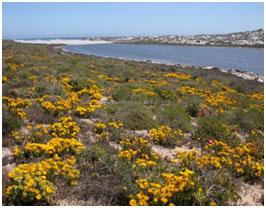
Nurture Restore Innovate uses extensive and ongoing ecological research, combined with entrepreneurial acumen and an understanding of socio-economic needs, to design and implement restorations systems that restore globally important biodiversity and generate livelihoods through the rehabilitation of degraded lands.
Future land use: A mine ends, what happens then?
Against the backdrop of climate change, there is a quiet, more immediate crisis of environmental degradation that threatens South Africa’s economic and social well-being.
More than 34% of South Africa’s terrestrial habitats are degraded including most of the country’s coastline. Nearly 70% of the coast of Namaqualand has been impacted by a century of diamond and heavy mineral mining. Although the mining is patchy, approximately 30 000 ha have been transformed by mining into tailings dumps, open pits, prospecting trenches, and access roads.
Far-thinking South African legislation requires that mining companies restore the land they mine to a “the previous natural, or alternative economically sustainable land use” (Minerals and Petroleum Resources Development Act, Section 39) as the foundation for sustaining economic activity in former mining areas. Yet, in the fragile landscape of Namaqualand, severe climatic conditions and high biodiversity combine to create extremely challenging restoration conditions.
As part of the Succulent Karoo Biome, the world’s only arid biodiversity hotspot, 40% of the more than 6 000 plant species are found here and nowhere else, yet the Namaqualand coast receives only 50-150 mm of rain per annum and has one of the strongest wind regimes on earth. Generally, once an area is mined, the ecology of this fragile and diverse system is disrupted and the native vegetation does not naturally re-establish, even decades after mining has ceased.
Socio-economically, as mineral resources are depleted and mines in the area downscale or close, unemployment and social degradation proliferate. Livestock grazing and ecotourism (particularly for the mass floral displays) are a critical livelihood options in this harsh environment and the restoration of ecosystems from a mine-degraded state to a natural rangeland, with high floral diversity, is essential for the future of the people living there.

Mining operations along the Namaqualand coast.
A Unique Business Approach: Restoring Landscapes and Livelihoods
Motivated by the scale of destruction and inspired by a vision that while diamonds may be forever, the damage caused by mining need not be, Dr. Peter Carrick set up Nurture Restore Innovate (NRI) to bridge the traditional divide between ecologists and mining and provide new solutions to the degradation challenges in Namaqualand.
Understanding ecological dynamics and planning restoration at the landscape scale, instead of for individual sites on an ad hoc basis, the NRI approach has created a pioneering framework that is firmly rooted in rigorous science, but has been developed into integrated best practice systems for the entire Namaqualand Coast, including: training courses, mentoring and technical support, simply packaged restoration protocols, contracting and payment models, and monitoring and assurance systems.
To implement its framework, the NRI brings a rare social and environmental entrepreneurship strategy to the mining sector and exclusively engages in long-term partnerships that allow the NRI to create and foster locally-owned restoration businesses to carry out the restoration at scale. This model has resulted in the seamless integration of restoration into mining business practices, and generated both jobs and future livelihood opportunities for the communities living in mining areas. The approach has been dramatically more effective than the established business and consultancy practice in which short term engagements and generic reports (often based on other sites that may not be appropriate for the conditions) are rarely translated into implementation. The tangible value of the NRI approach is that ecological restoration, locally-owned businesses and on-going research is financially sustained by the mining sector and this ensures real job and capacity development in the region.
Read more about business development by the NRI.
|
The purpose of the NRI is “to establish a restoration bench mark, and develop new and effective regional protocols based on sound ecological dynamics for the achievement of near-natural biodiversity restoration, while giving a cross-section of the regional community a greater role in restoration, and through active service-driven engagement with mining operators, and other land users, to fundamentally change the way they perceive their roles and responsibilities with regard to biodiversity conservation and restoration.” |
Achieving the “impossible”: Pioneering New Techniques
Global knowledge about the restoration of arid habitats is inconsistent and is often based on agricultural techniques rather than ecological understanding. Prior to the NRI many mining companies claimed that returning the Namaqualand coast to a natural state was “impossible”. Prior rehabilitation efforts by mining companies, where they existed, were based on re-establishing plant cover with no consideration of key indigenous species or the plant community interactions that are fundamental to ensure that the vegetation is resilient to climatic and other stresses (e.g. extreme wind, drought, pest outbreaks, etc.).
Based on extensive long-term, on-site experimental trials, the NRI has developed a pioneering “restoration pack” technique which combines the seeds of plants adapted to grow in the specific site conditions together with biodegradable plant shelters (often, simply cardboard boxes) and plants them in a patch layout at different scales. These techniques mimic the natural environment where seedlings often grow up under the shelter of old or dead shrubs, and where plants grow initially in patches (e.g. where water collects), and spread from there.
On-going monitoring of the initial 2600 experimental plots indicates that the ecological complexity and diversity of the area gradually increases after the critical, initial input by the restoration teams. To date, the technique has been applied to restore diversity on over 500 hectares of degraded land and the low-mechanisation, high-labour technique is generating remarkably cost-effective results for the unique and challenging Namaqualand coast.
The new NRI techniques provide an important model for other ecologists working in restoration, and the restoration pack system is now being adopted for efforts in other challenging arid ecosystems, including the Shark Bay World Heritage Site in Australia.
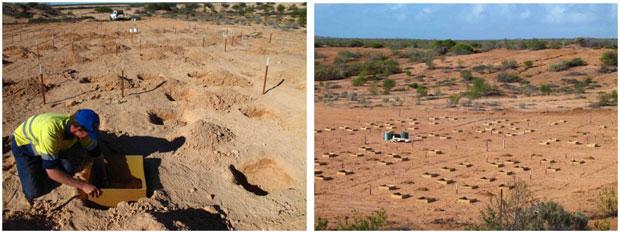
Dr Ellery Mayence of Kings Park Botanical Gardens setting up a restoration pack trial in Shark Bay, Western Australia
Read more about the science conducted by the NRI.
Making a real difference: Long-term livelihood development
At its height, diamond mining in Namaqualand employed over 6000 people. Today, the scale of mining operations is a fraction of that, with only a few hundred jobs being sustained. Finding ways to create employment and involve local people in restoration is a critical component of the NRI approach.
Between 2007 and 2010, the NRI provided formal ecological and restoration training to 120 Namaqualanders. In 2007, the NRI started a process to develop the first local restoration businesses that were entirely owned and run by Namaqualanders, to service mining companies. Once considered to only be seasonal work, innovative commercial arrangements designed by the NRI for the restoration businesses created a breakthrough for the development of restoration as an economic sector by ensuring a continuous revenue stream throughout the year.
On-going contracts between regional mining companies and the NRI-catalysed businesses provided year-round work for 15-30 people until the sale of major mining operations in 2013. When restoration of past and current mining operations recommences, the number of people these businesses employ and the number of hectares they can restore will increase proportionally, bringing new hope that healthy ecosystems will be available for future use by Namaqualand communities for livestock grazing and ecotourism after mining completely ceases.
In keeping with its ambitious approach, the NRI is now tackling a new challenge of finding solutions for degraded rangelands, applying the same passion for people, social and environmental entrepreneurship, and rigorously researched methodologies, to healing Southern Africa’s degraded arid lands.