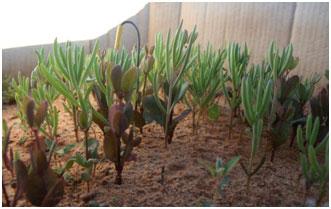
Rigorous ecological research underpins the development of restoration systems and complex field experiments are used to develop an ecosystem-based understanding of the range of conditions and responses that operate in the ecosystem.
Namaqualand ecology and mining
The ecosystems of Namaqualand are particularly challenging to restore due to the unique floral diversity (double that than any other arid system), strong prevailing winds, very low rainfall (50-150 mm per annum) and complex spatial and biological dynamics. Generally, once an area is mined, the ecology of the system is so disrupted that the native vegetation does not naturally re-establish, even decades after mining has ceased. This is primarily due to the fact that the mining process has altered the soil substrate and removed the patch dynamic processes that operate in it (which allow for resources to be concentrated in patches and support plants and other biota). The mining process typically excavates ‘overburden’ soils from depths of up to 30 m or more and deposits these on the surface. These soils are sterile (have no animal or plant life or their propagules), are generally very low in the nutrients which support life, and are often too saline to support most plant growth.
Building on existing understanding
The NRI builds on decades of ecological research in arid ecosystems and restoration research both in southern Africa and globally. In the late 1990’s there was a burst of high quality ecological research focused on Namaqualand. This research contributed evidence that allowed for the development of a more comprehensive understanding of the important dynamics pertaining in the region, and more importantly, provided focus for unique aspects of Namaqualand ecology, and the differences between this region and other semi-arid areas.
Before launching our experimental programme, we set out to capture and integrate our understanding with local knowledge, and other expert knowledge, from beyond the scientific community: Twenty four interviews were conducted with different land-users in Namaqualand, who had practiced some form of restoration, to record their experience in improving degraded areas. The interviews allowed the practitioners and scientists to visit and discuss their degraded and restored areas together, and for the collective local knowledge to be assimilated and synthesized in order to inform the research and restoration protocols. One specific that emerged from this process was an understanding that the primary constraint to seedling establishment was wind, and not water as previously expected by many working in this arid system.
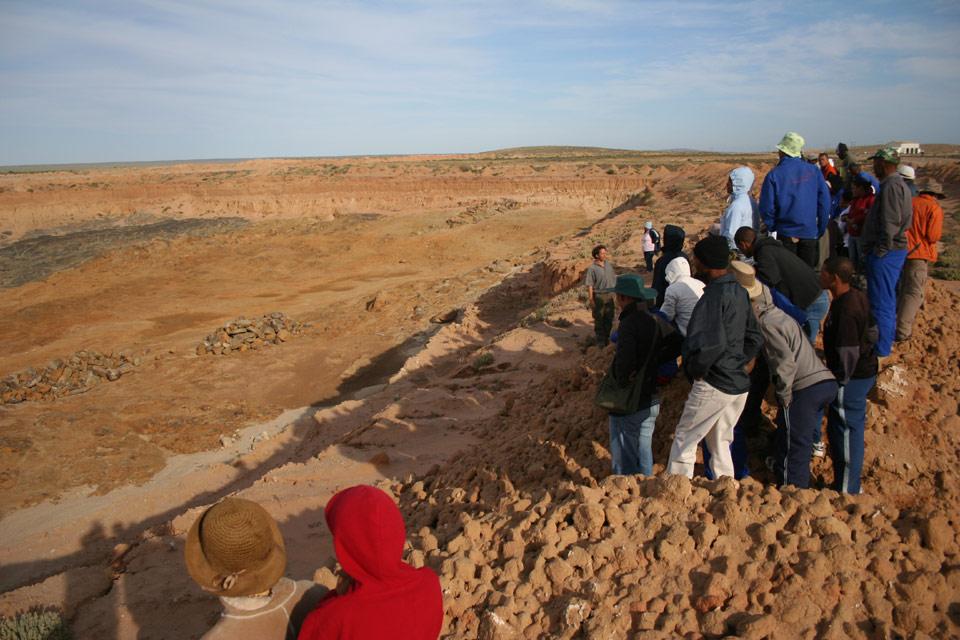
People from Namaqualand discussing mining scars found in the region
Exploring the relevant ecology of the system
To augment ecological understanding, we facilitated a multi-disciplinary study involving 12 experts working together at the same 6 field sites on a short but intense study to elicit patterns of restoration across different groups of organisms and soils (soils, fungi, bacteria, nematodes, vegetation, soil crusts, arthropods, small mammals, large animal indicators, vegetation, transplants, decomposition and nutrient cycling). This confirmed that a patch dynamic approach to restoration was more likely to succeed for restoring other elements of the natural fauna than the prior methods applied.
Patch dynamics were an area of intense study. Traditional restoration efforts in the region had applied agricultural techniques (e.g. mechanical spreading and ploughing, which effectively homogenizes of the soil, and broadcast seeding or row plantings) to degraded mining areas with limited success (particularly where topsoil was limited). Yet, prior ecological research indicated that natural patterns in this water and nutrient poor system are based on a concentration of resources for plant growth in patches. Various ecological dynamics related to competition and “nursing” (facilitation) take place within and between these patches. We studied the natural “patch” layout in undisturbed areas of various soil types to better understand these relationships in order to inform the development of a research design that would best mimic natural patterns.
Understanding the unique ecology of Namaqualand: seed dormancy, seed dispersal, seed banks and thresholds of seed availability that need to be overcome for restoration, together with the role of high wind regimes, and the most effective windbreaks to provide soil stability, were the specific building blocks for developing research in ecologically-based restoration.
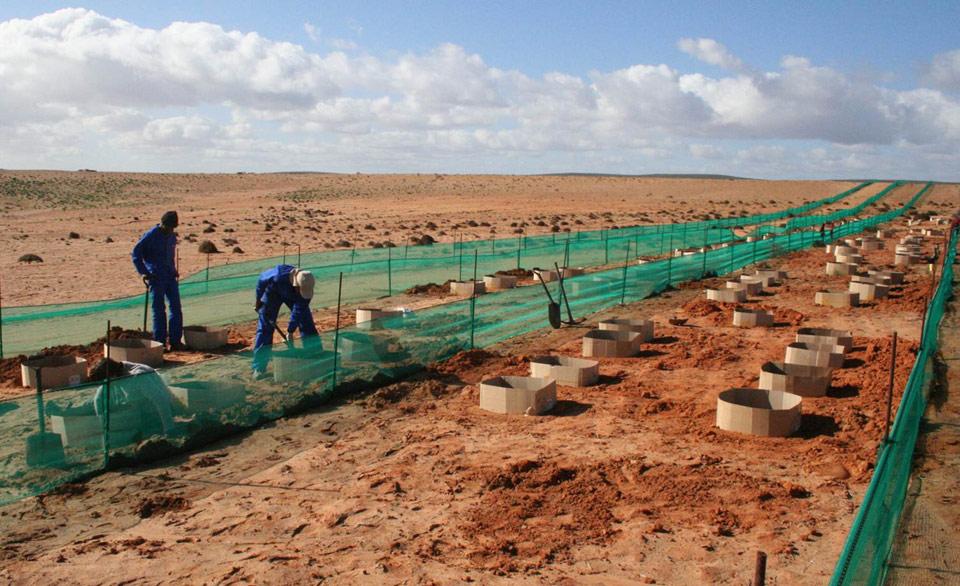
Setting out a field experiment to re-create patch dynamics in order to fast-track ecological restoration in Namaqualand
Rolling out extensive field experiments
The NRI research prioritized extensive, geographically disbursed studies that extended throughout Namaqualand from the Olifants to the Orange River, and were independent of mining operations (but conducted across a range of mining operations), which allowed us to explore ecological and restoration dynamics for the region, rather than for a particular site. In this first phase, we specifically investigated physical and biological bottlenecks to the establishment of young plants at degraded sites under a variety of conditions.
The large-scale experimental programme began in 2005, with factorial seedling experiments testing, among others, the roles of competition, nutrient availability, soil salt content, water availability etc. Assigning indigenous plant species to regionally-defined functional groups the experiments were replicated at sites in northern and southern areas of the Namaqualand coast in both undisturbed and degraded systems (and across a range of soil conditions from good topsoil to overburden).
A number of additional studies and experiments were conducted to support the large-scale field experiments, e.g. experiments in the glasshouse involving bioassays and testing soil amelioration and fertilizing methods on various soils; and germination trials in growth chambers on viability and variability in germination rates and methods for breaking seed dormancy.
The scale of the experiments was then expanded and transitioned from understanding the underlying ecological dynamics to trialing specific restoration interventions.

Seed germination trials in growth chambers and bio-assays of different soils in the glass-house
Using ecological dynamics for innovative restoration
In 2006 we integrated the knowledge of seedling growth, soil conditions, and patch dynamics into a second series of large-scale field experiment (in total 1300 plots). In these experiments we started to trial restoration techniques while simultaneously experimenting with applied ecological dynamics (e.g. the impact of indigenous ‘nurse-plants’ on seedling establishment versus that of artificial biodegradable ‘nurse-shelter’), and we started to develop the concept, and use of restoration packs.
In 2007 we rolled out another large field experiment where we built on the results of the 2006 field trial to further refine the restoration pack methodology. We used approximately 1500 seeds of more than 15 perennial species in each restoration pack, supplied with soil supplements and testing artificial ‘nurse-shelters’ (again just over 1300 restoration packs) across eight sites that represented a range of soil types typically found in mined areas (including those where topsoil was re-applied, and overburden i.e. those where topsoil was absent).
A number of important findings emerged from these two large restoration experiments, and were immediately incorporated into methods that could be rolled out by a small restoration team (of 18 people) on one of the mines. Thus the implementation of ecological restoration was started, and ran, in parallel with continued research.

The figure illustrates how restoration packs (RP) are spaced within patches and between patches in order to re-establish the ecological structure of an area, which will allow natural plant and animal establishment in the future.
An integrated monitoring and trouble-shooting system
A key concern in any restoration programme is the determination of whether restoration in a specific area has been successful. Again using ecological principles, we developed a quick and easy monitoring and evaluation tool to measure whether a site has been successfully restored or not. The system consists of a scoring system that is based on a simple conceptual understanding of functional types of plants (far more easily grasped than that of species) and can be used by people without requiring detailed knowledge of plant or animal species, or expensive and remote tests, e.g. soil analysis.
The system was developed by integrating and simplifying ecosystem components and functions into a points-based system that is weighted according to the importance of the components and functions for Namaqualand habitats. The system was tested, compared with other methods, and refined on 22 sites that ranged from near-pristine undisturbed sites to degraded mine sites, and has been calibrated so that it can be used objectively anywhere along the Namaqualand coast to assess recovery.
The system provides an objective assessment of how far along the path to restoration any area has come, and which aspects of the ecosystem are restoring slowly or have encountered thresholds to restoration.
The NRI is now undertaking new projects in partnerships that are also long-term (three years or longer) to find solutions to other land degradation challenges. In the long-term, it is hoped that the future value for South African communities from the NRI will come in the form of real solutions to all types of degraded lands and expanded employment opportunities for ecological scientists and the unemployed in those areas.
Read more about new projects being conducted by the NRI.