Launched October 2022!
“Met bykans drie dekades se navorsing en toetsing van benaderings tot restourasie, het Peter Carrick en sy span die eerste boek van sy soort vir Suid-Afrika geskryf.
Hoewel dit op goeie wetenskap gebaseer is, gaan die boek oor die “hoe”.
Die nege hoofstukke is geskryf op ‘n manier wat vir almal toeganklik is en bied die jongste restourasiemetodes wat vir Namakwaland geskik is.”
Prof Kingsley Dixon – Voorsitter,
Society for Ecological Restoration
Only R 290

Thanks to our sponsors
For five books or more contact:
The book is written in Afrikaans
The book is written in Afrikaans and focuses on the Namaqualand region of the Succulent Karoo (especially the Sandveld and Hardveld bioregions). However, the ecology and restoration methods outlined also apply to the Richtersveld (usually considered part of the Namaqualand) and the Tankwa-Karoo (normally not considered part of Namaqualand).
The methods outlined in this book are also suitable for most ecological restoration problems in adjacent areas of the Succulent Karoo, namely the Hantam, Roggeveld and Klein-Karoo. These are also applicable for the restoration of plant communities in the Nama-Karoo biome and other semi-desert regions where woody shrubs or succulents are common. Additional guidelines should be consulted for specific ecosystem conditions and threats in more distant regions such as grassland areas where ostrich farming occurs.
Vir ‘n glimpsie van die boek, blaai asseblief deur die eerste paar bladsye.
For a glimpse into the book please browse the first few pages.
Professor Kingsley Dixon provides an insight to the book, its contents and the importance of restoration within regions which have undergone immense degradation over the years.
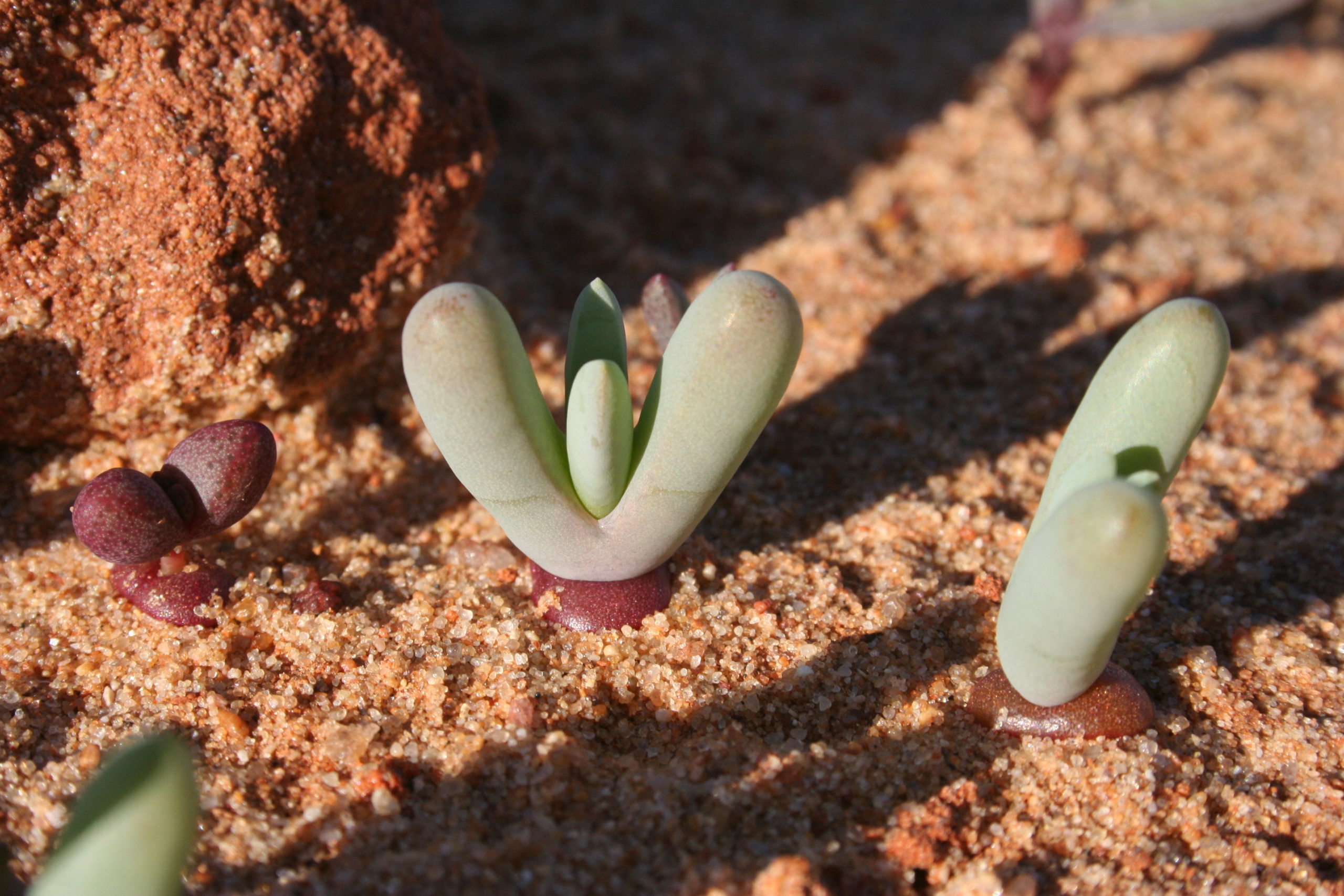
Though gone today, great grazing herds would migrate with the rains to dine on the abundance of plant life in Namaqualand. Springbok once passed through gaps between mountains, reportedly 30 abreast for three days. Shot, hunted, and fenced out from their natural grazing lands, the episodic grazing events created by such animals were quickly replaced by permanent year-round grazing by sheep and goats. Vegetation was unable to respond to this constant high intensity grazing, intermittent clearing and ploughing for cereal crops. Surface erosion took hold and degraded landscapes lost valuable resources like seeds, topsoil, fertile patches and, finally, all but a few unpalatable plants.
The arrival of mining for copper and diamonds meant areas free from agriculture were often left wastelands. With the global appetite for heavy minerals rising exponentially, Namaqualand’s deep alluvial coastal sands are now the focus of mineral sand-mining.
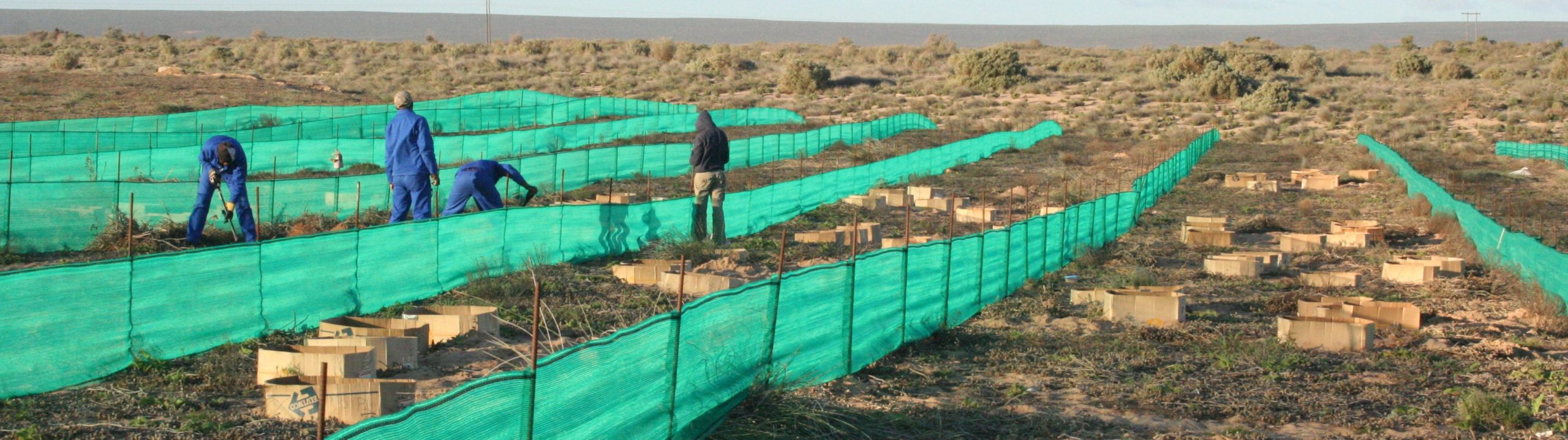
Deploying the most destructive of all mining methods, strip mining, large areas of natural ecosystems living atop mineral-rich sands are quickly converted to wind-blown, degraded landscapes.
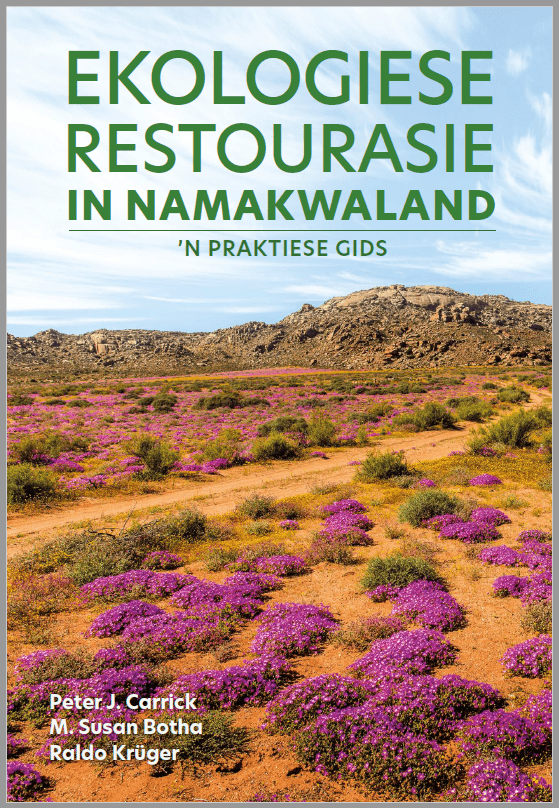
This is why this book, Ekologiese Restourasie in Namakwaland: ‘n Praktiese gids, is the right book just at the right time!
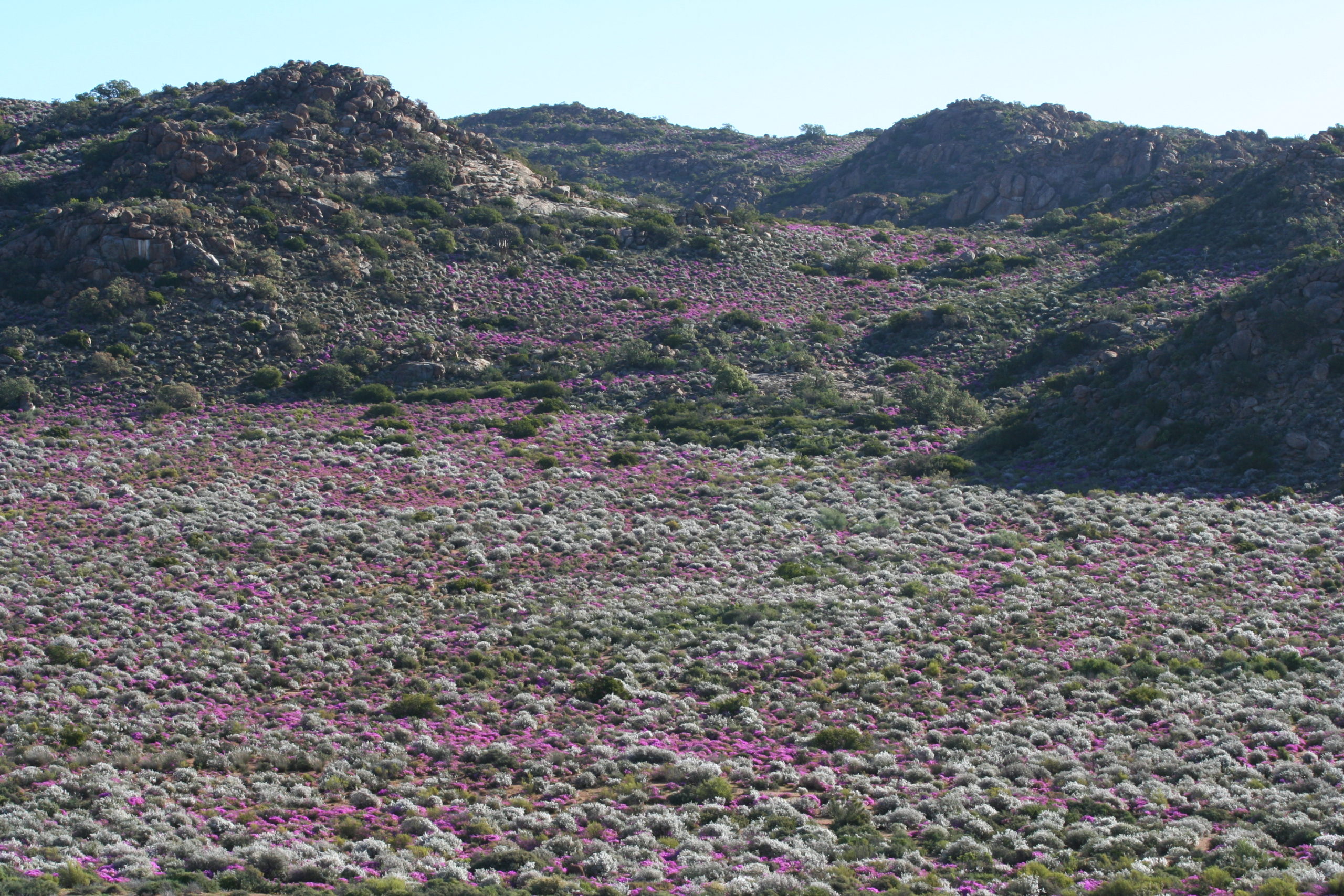
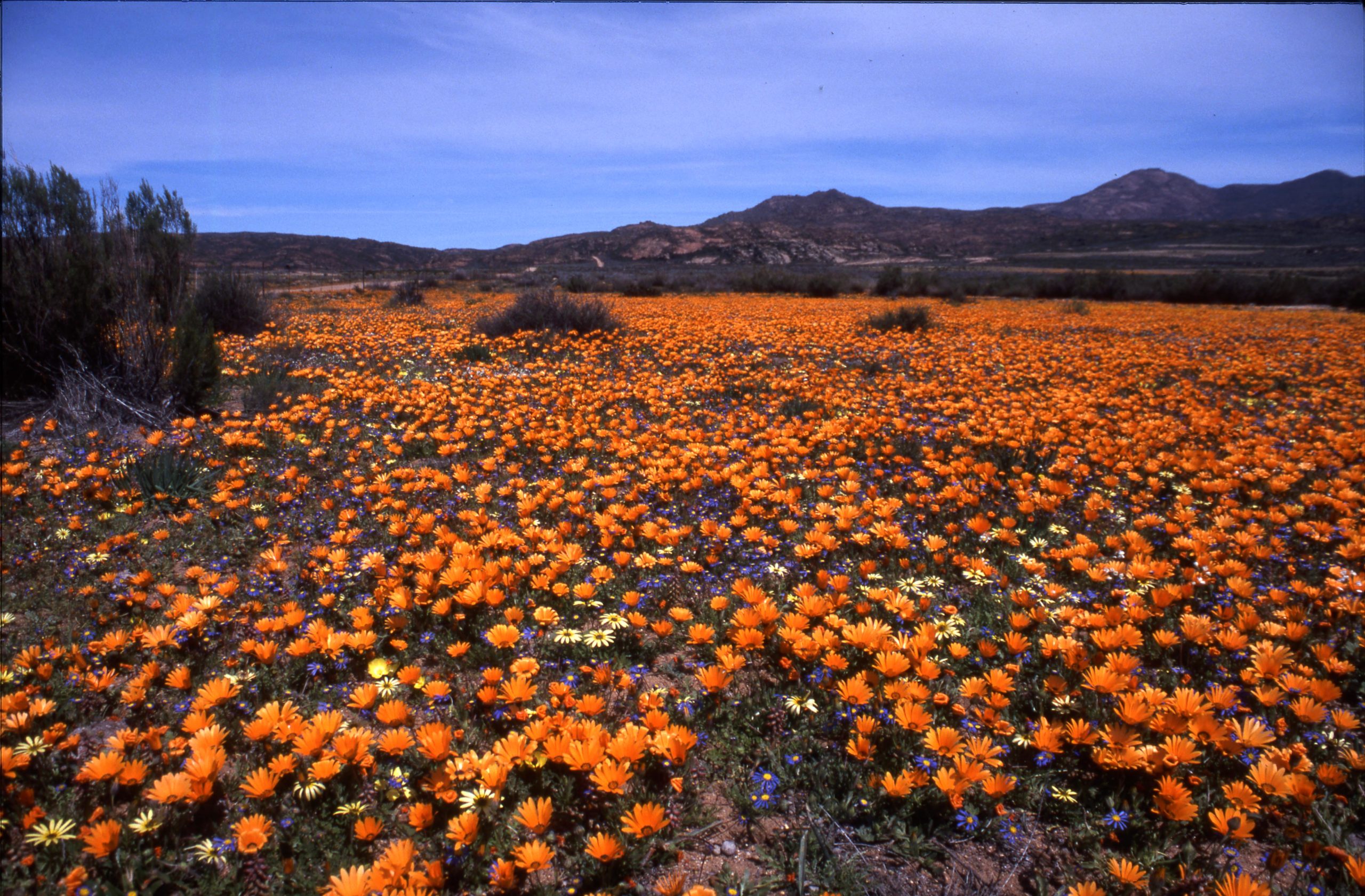
Here the NRI team, led by Dr Peter Carrick, world-acknowledged expert on ecological restoration of this semi-desert ecosystem, has assembled a formidable armoury of restoration techniques and technology to halt and reverse degradation and sustain the natural ecosystems of Namaqualand . Three decades researching and testing restoration approaches, Peter Carrick, Susan Botha and Raldo Kruger have written the first book of its type for South Africa.
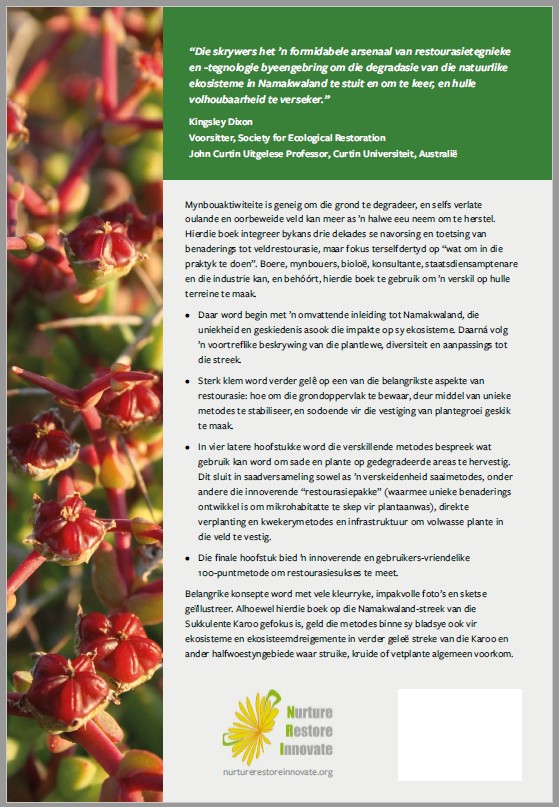
Although based on robust science, the book is about ‘can-do’- farmers, miners, consultants, government regulators and industry can, and should, all use this book to make a change in their patch. Written to be accessible to all, the nine chapters represent a state-of-the-art restoration tool-kit for Namaqualand.
This book focuses on to major systems: coastal sands (Sandveld) impacted by mining, and rocky landscapes (Hardeveld) degraded by cropping and grazing. These ecosystems need human intervention, ingenuity, and science to reverse soil degradation and bring them back.

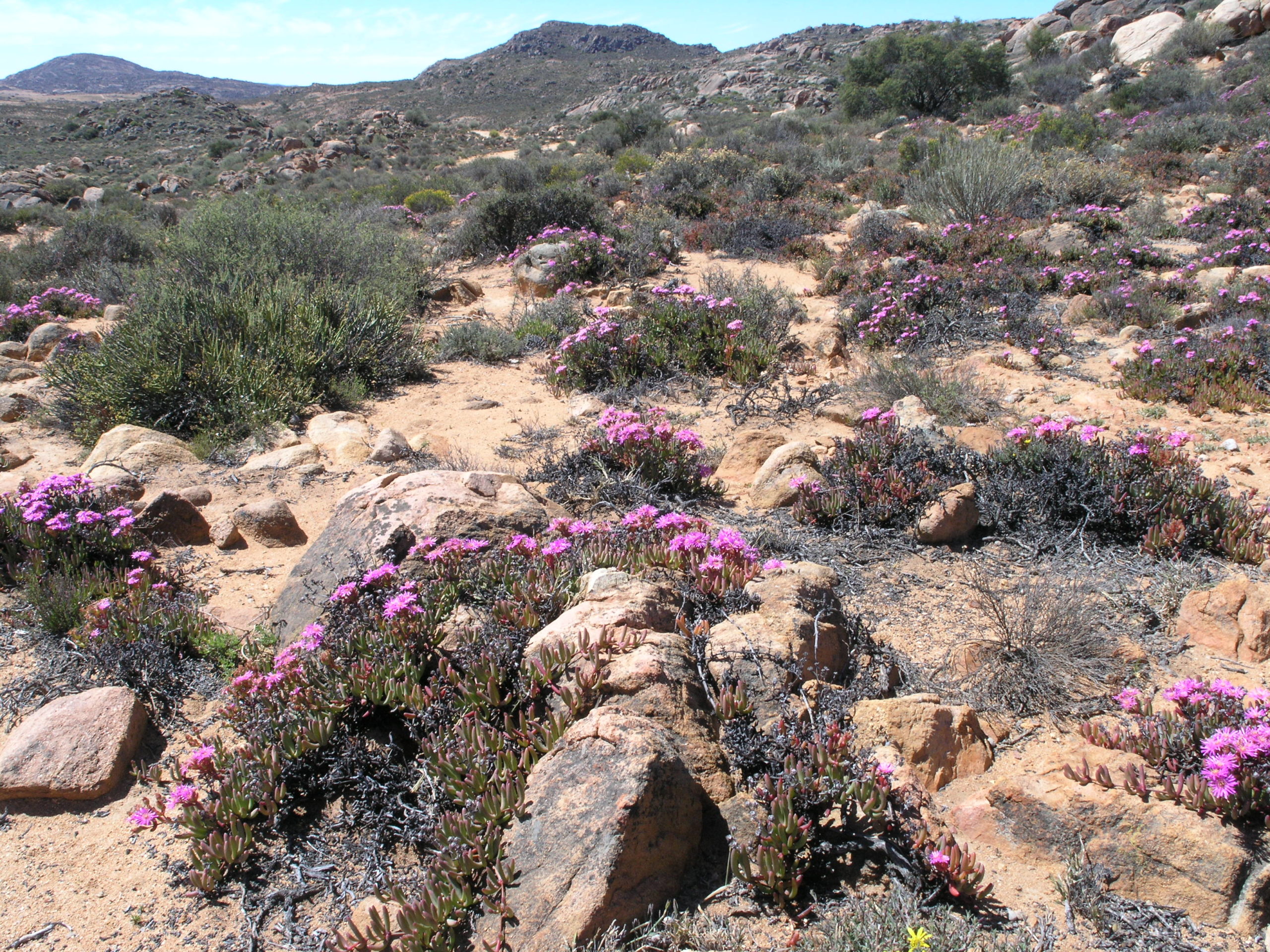
The book starts with a comprehensive introduction to the region, its uniqueness, history, diversity, and the impacts to its ecosystem. This leads onto Chapter 2 which introduces the plant life, their adaptations and ecology of the region. Important aspects of restoration are covered in Chapter 3: how to get the soil right. Innovate methods used to stabilise land surfaces in areas where high winds and localised flooding occur due to the absence of plant life are covered in Chapter 4. The art and science of seed collection is introduced in Chapter 5, ensuring restoration opportunities are maximised by fleeting periods of seed ripeness. Chapter 6 covers the NRI’s “restoration packs”, where the team devised unique approaches for creating plant recruitment niches and microhabitats to maximise restoration success. Chapter 7 and 8 discuss direct transplanting and nursery production methods. The final chapter provides an innovative and user-friendly 100-point system to assess restoration success.
I recommend this book to all who care for the planet and the protection of unique and irreplaceable places like Namaqualand.
Kingsley Dixon
Chair, Society for Ecological Restoration
John Curtin Distinguished Professor, Curtin University, Australia