
NRI projects have also brought their passion for the restoration of arid lands to croplands and rangelands, applying the same passion for people and the environment, driven by rigorously researched methodologies.
Restoring rangelands in Namaqualand
While Namaqualand’s coast has been extensively degraded by mining, Namaqualand’s uplands (mountains and rocky hills) have been extensively degraded by ploughing and cropping. The settlement of indigenous peoples (who had followed a largely nomadic lifestyle) and early European farmers in Namaqualand in the 1700’s lead to large areas in the uplands ecosystems being ploughed for crop production (wheat, oats, barley and rye). In the 1970’s the area used for cultivation peaked at close to 30 000 Ha. Due to social and economic factors, cultivation drastically declined from the 1980’s onwards and currently only about 10 000 Ha of land is under cultivation.
Socio-economically, the lack of farming resources, low market values for products and a rural-to-urban migration of the youth has resulted in much of the old farming practices being abandoned. These factors, coupled with mine closures along the Namaqualand coast, have resulted in rising unemployment in upland communal areas. Livestock farming with sheep and goats is a critical livelihood option. However, repeated ploughing and prolonged utilization of the veld by high densities of livestock has changed the vegetation composition and ecology of the productive plains and pediment areas. Animal numbers fluctuate from year to year as a result of the replacement of perennial shrubs by annuals and short-lived plants, which decreases the availability of dry-season forage and renders animal populations more susceptible to the impacts of drought. Agricultural crop cultivation has proved to be unsustainable in Namaqualand and has left a legacy of disrupted ecological processes and degraded the productivity of rangelands. The restoration of these ecosystems to a natural rangeland, with high floral diversity, is essential for the future of the people living here. Restored rangelands will provide sustainable grazing for livestock, and ecosystems that offer resilience to unpredictable climate patterns and the vagaries of future land-use patterns.
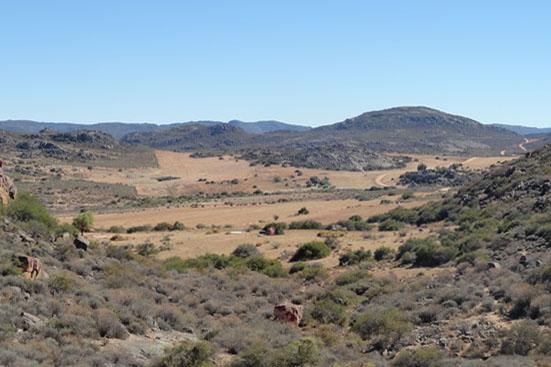
Ploughing of Namaqualand upland areas clears these ecosystems of productive perennial plants
Exploring the relevant ecology of the system
Extensive ploughing and heavy grazing has transformed the productive Namaqualand uplands from ecosystems dominated by a rich diversity of shrubs and succulent plants to ecosystems dominated by a single, unpalatable ‘problem plant’, namely, Galenia africana (kraalbos) in Succulent Karoo, and Elytroppus rhinocerotis (Renosterbos) in Renosterveld, ecosystems. Recovery of old fields without active ecological restoration proceeds very slowly, and at best may take many decades.
Before launching this project, the NRI set out to capture and integrate our understanding with local and expert knowledge of the region. We met with numerous farmers, both communal and private, walked through rangelands familiar to them and shared discussions. We also sought out older people in these communities who could visit the croplands with us and discuss the detailed history of land-use in each. In early 2013, cropland and rangeland areas around two upland villages were identified as foci for research: Tweerivier within the ‘Hardeveld’ (rocky hills) with Succulent Karoo ecosystems; and Leliefontien at the highest elevations (mountains) with Renosterveld ecosystems. The NRI held community meetings in both villages to introduce our ideas for restoration. Local knowledge was harnessed to extensively scout these areas, and finally six sites were identified as research sites (three with a good generalizable land use history in each of the two ecosystem types). Local workers fenced off the sites to protect them from grazing, and local people with a good understanding of the area and the plants were used to help collect seeds of indigenous species.
Contrasting results within the two ecosystem types under the same experimental design are providing important insights into the functioning of these ecosystems, and key opportunities for restoration in each.
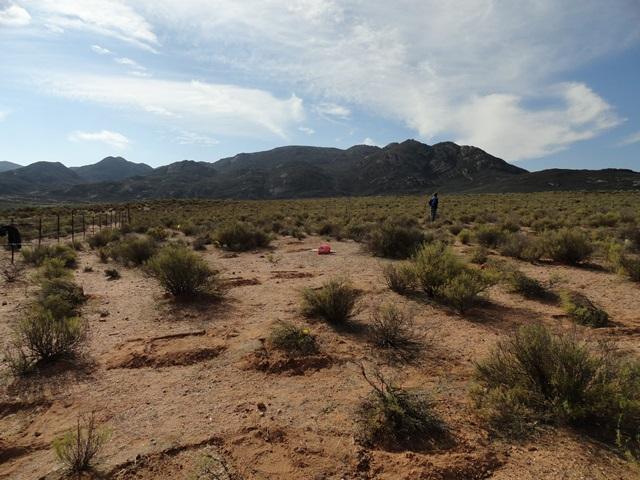
Setting up a large-scale restoration experiment in an old cropping area where only kraalbos plants have managed to establish after ploughing ceased
Rolling out extensive field experiments
The impulse of land-users has been to eradicate the abundant ‘problem plants’. Large scale clearing of these shrubs costs a great deal in time and effort, and simply creates large open areas vulnerable to erosion by wind and water. Moreover, the seedbank is dominated by the same ‘problem plants’ and eradicated plants are therefore rapidly replaced by more of the same. The NRI approach is to use these ‘problem plants’ as key foci for restoration, in order to facilitate the establishment of a broad diversity of indigenous perennial species. These so called ‘problem plants’ provide structure to the ecosystems and can improve conditions, both above and below ground, for newly establishing perennial plants. Above ground, these plants can provide protection from animals and the harshest environmental conditions beneath their canopies. The soils under these plants may also be more fertile, due to the addition of leaf litter and faeces from small animals seeking shelter under the plants, and shading increases the water available in the shallow soil beneath the canopy.
The small patches created by these ‘problem plants’ provide more favourable habitats for seedlings to establish, and the canopies either alive or dead, can be utilised as ‘nurse-plants’. Patch dynamics have been an area of intensive study by the NRI, in order to mimic the natural environment and benefit from the most suitable conditions for seed establishment. Evaluation of the restoration pack technique utilized by the NRI and partners along the Namaqualand coast has proved the effectiveness of patch dynamics in restoration. In the Namaqualand uplands we trial artificial ‘nurse-shelters’ (similar to the restoration pack techniques used on the Namaqualand coast), but concentrate on methodologies for using ‘problem plants’ rather as ‘nurse-shelters’. We are testing combinations of leaving some live plants to provide protection and structure to the ecosystem, and killing some plants in order to make use of the protection offered by the above-ground brush, and below-ground fertile patches, without potential competition being exerted on new establishing plants in these patches from living plants.
The large-scale experiments began in May 2013 (to coincide with the annual winter rainfall season), with a factorial seedling experiment to test the role of competition from renosterbos and kraalbos on the establishment and growth of seedlings. Other aspects of patch dynamics were tested in paired combinations (patch and open area) overlain with various treatments, e.g. fertilizer additions, artificial depressions (which ingeniously retain the fertile islands and surface soil), dead brush and artificial ‘nurse-shelters’. In each of the six fenced sites 50% of the renosterbos or kraalbos were carefully killed (so that the nutrient islands and soil were not disturbed).
We used approximately 1400 seeds of 20 indigenous perennial plants, selected to ensure the restoration of species from a range of regionally-defined functional groups (from grasses, succulents, and perennial herbs to small and large shrubs). For the next three years 1170 plots will be monitored intensively in order to determine the most effective combination of conditions for restoring biodiversity, in the most cost-effective way.
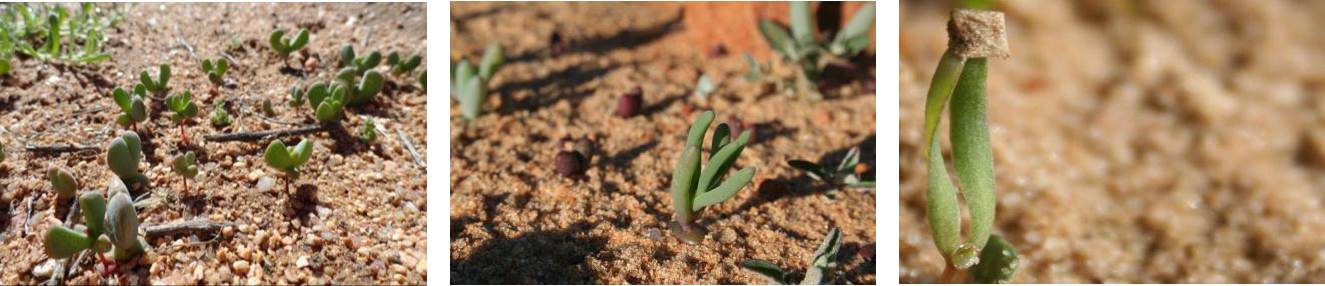
Seedlings of characteristic succulent plants emerging two months into the rainy season in restoration plots
A future for people and the environment
Indications are that the degraded areas have a seedbank below-ground dominated by the ‘problem plants’, and a very reduced the seed bank of other palatable perennial plants (the same pattern seen in the above-ground vegetation). In further studies, we are undertaking a thorough investigation of the seedbanks of ploughed areas recently left fallow, and areas left fallow for some decades, and contrasting these with seedbanks in natural rangeland subject to intensive grazing, and those rested seasonally from grazing. Similar vegetation studies are being conducted above-ground, in order to better understand the successional trajectories of recovery in these rangelands under different conditions. More importantly, these studies are designed to help us identify bottle-necks in recovery and to optimize natural dynamics in breaking through these bottle-necks.
The NRI has already brought a unique social and environmental entrepreneurship strategy to the mining sector along the Namaqualand coast. It is hoped that similar programmes can be initiated in the farming communities of the Namaqualand uplands, in order to uplift these communities and the unique and diverse ecosystems that support them. In 1995 the South African government initiated the Working for Water programme, and massively expanded it in 2004 into the Expanded Public Works Program (EPWP). The EPWP provide people with a basic livelihood while they work on projects to improve their local environment. The EPWP objectives include promoting community-based natural resource management, the rehabilitation of natural resources and protection of biodiversity. EPWP could provide an excellent support structure for rolling-out restoration in Namaqualand on a large scale, and thereby provide a greater section of the community with a role in the restoration of their natural environments, while simultaneously alleviating poverty by creating work opportunities in the short-term and restoring productivity to degraded rangelands in the long-term.
The NRI has the ambitious aim of extending such research projects towards implementable restoration protocols as a new ‘Working on Dry Rangelands’ initiative within South Africa’s Expanded Public Works Programme.
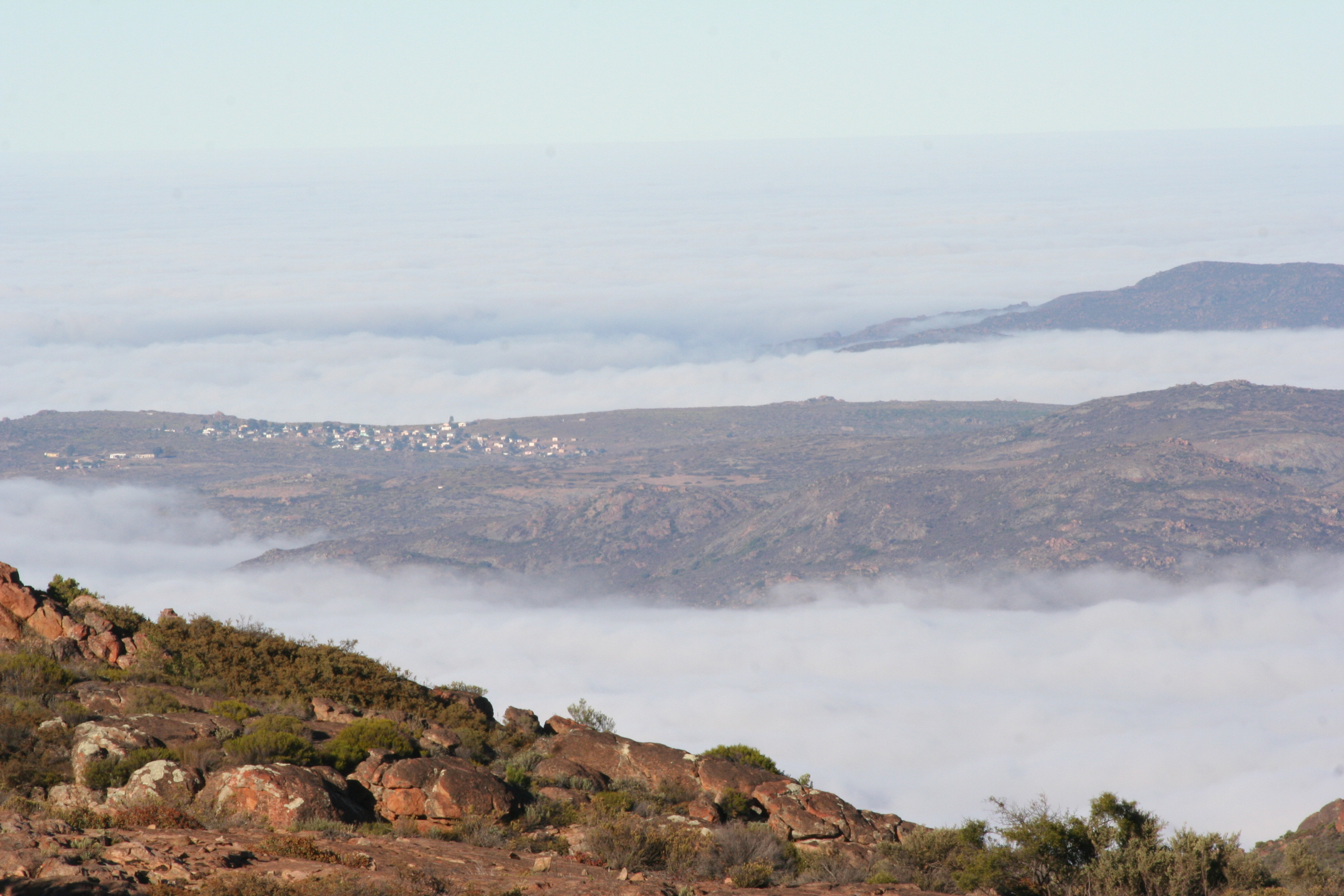
Villages in the Namaqualand uplands supported by rangeland ecosystems